> **Note:** This is obviously a joke article, please don't take it too seriously.
When one considers high-power wireless transmission one cannot but consider the application of the same to the culinary arts. As an example, take the famous dish of [fried chicken](https://en.wikipedia.org/wiki/Fried_chicken), as shown in the below figure:
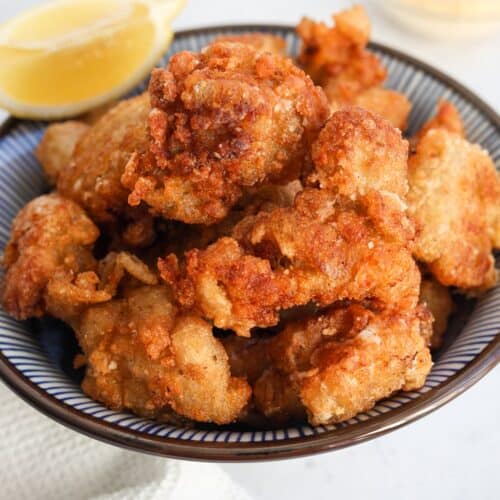
To fully appreciate the conveniences and usefulness of the laser technology we are developing (see [[Prototype free-electron maser design]] to actually read about it), we must certainly analyze how to cook chicken with our lasers - so here it is!
> **Note:** When we say "chicken" we mean a generic term, which includes normal chicken as well as vegetarian/vegan meat substitutes.
## Effects of naive radiative heating on chicken
To consider the radiative effects of a microwave laser on chicken, we must first review the basics of the model that all lasers - microwave or visible-light - are based upon. This is the Gaussian beam, which you can read more about in [[Ideal laser beam divergence]] and other articles. The Gaussian beam model tells us that the intensity of the laser beam falls off approximately by:
$
I(r, z) \sim I_0 e^{-2r^2/w(z)^2}
$
That is to say, the beam's energy disperses with distance as it diverges (spreads). This is, interestingly, a good thing! An overly focused beam would be able to only heat chicken for a short moment in pulsed operation, but even in the CW (continuous-wave) masers we use, heating the very center of the chicken does nothing to spread the heat out. This leaves us with a burnt chunk through the center of the chicken and the rest of the chicken staying raw. Indeed, it then makes sense why household microwave ovens also use a **resonant cavity** that bounces the microwaves around, ensuring even heating.
> **Note:** We are also assuming we tune our free-electron masers to $\pu{2.45 GHz}$, aligning with a strong absorption band of the water molecule. If we keep them within our standard wavelength range of $\pu{1-2GHz}$, little to no cooking will take place.
This, of course, is only true in vacuum. It is a very different story if we consider the chicken surrounded by ambient air. While air does not absorb (or heat up from) microwaves on its own (hence why we use microwaves for wireless power transmission), the heating of the chicken (which contains solid fibers and liquids) would be sufficient to cause spontaneous combustion of the heated portion. In fact, this combustion would be so rapid that it would lead to an explosion, destroying the chicken, the maser, and everything else around it!
## Okay...but how can we *properly* cook a chicken with lasers?
Failure is, quite often, the best teacher, and indeed here we can learn from our failures to devise a fool-proof strategy to cook a chicken with a maser. The key method is to route the maser beam through a **waveguide**. A waveguide causes microwave wavefronts to bounce in a zig-zag pattern, as shown in the below:
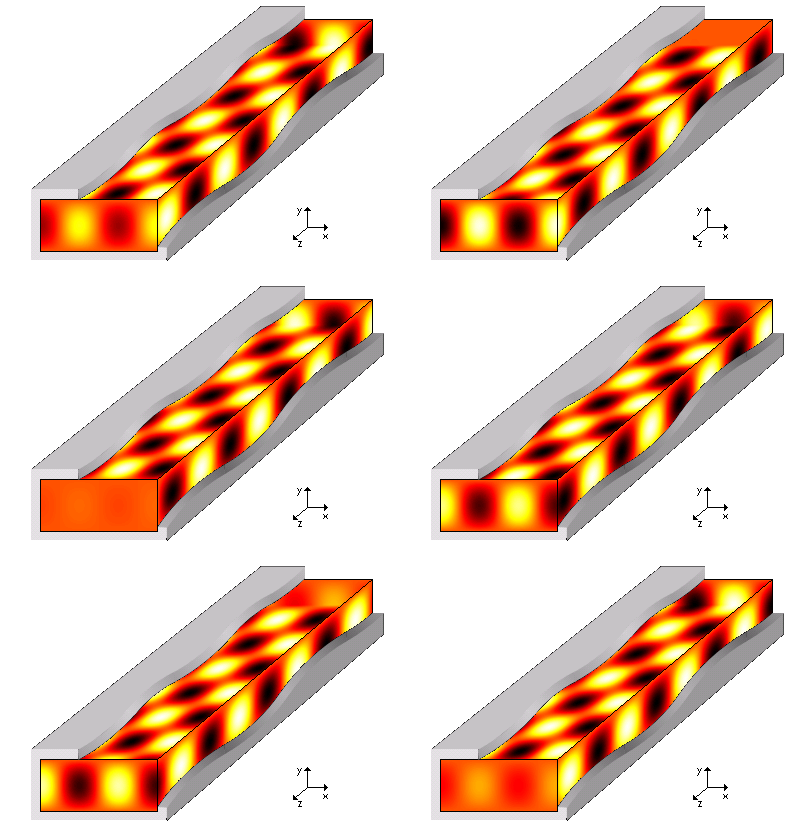
_Source: [Wikipedia](https://commons.wikimedia.org/wiki/File:Waveguide_x_EM_rect_TE31.gif)_
The Dirichlet boundary conditions of a waveguide require $E(\mathbf{x}) \to 0$ at all the edges, which results in the same behavior as a microwave. Unfortunately, the results would not be superb with just a waveguide; while the chicken (or vegetarian/vegan alternative) would be cooked through, it would taste more like it was boiled, as the microwaves would only heat up water within the chicken, making it watery and rubbery at the same time.
To properly *cook* the chicken, it would be necessary to use another, more sophisticated method. As with before, we need the waveguide to prevent the maser from just poking a hole in the chicken (in vacuum) or exploding everything (in air). We would then need two metal bars hung in front of the chicken that are polished and highly conductive. These two bars are placed adjacent to each other, perhaps only around $\pu{1-2cm}$ apart. Next, we need to use a high-temperature oil spray to create a "shower" of oil droplets within the cooking chamber. Turning on the maser would create both the echoing microwaves within the reflective cavity (cooking the chicken quickly within) as well as causing resonance (and thus very strong fields to build up) within and around the metal bars. At a certain point, the fields become strong enough to ionize the air, causing an electrical arc to build up between the two bars. But since the air is filled with oil droplets, the arcing sets the air on fire and becomes the equivalent of a very hot grill/fryer! This technique is essentially an *extremely* technologically-complex method of good-old-fashioned barbeque with some frying added in. Of all of the laser cooking methods we have discussed, it should yield the best results!
At least, *in theory*. Let's actually prove it with math!
## A quantitative analysis
Since a chicken is a relatively similar shape to a sphere, we will approximate a chicken as a sum of spherical harmonics:
$
C(\theta, \phi) = \sum_\ell \sum_m A_m^\ell Y_m^\ell (\theta, \phi)
$
Where we take $R = 1$ to normalize the chicken. Now, to understand the process of microwave-scattering on the chicken, we must first consider the process of hard-sphere scattering, which is simply the case of the $Y_0^0$ spherical harmonic for $\phi = 0$. It may be shown that the scattering cross-section (in essence, the effective cross-sectional area that the particles impact against) is given by:
$
\sigma = \pi R^2 = \pi
$
With higher-order harmonics, this cross-sectional area would change to $\sigma \sim \pi R^2\sum_\ell \sum_m A_m^\ell Y_m^\ell(\theta, 0)$, where $Y_m^\ell(\theta, 0) \sim P_\ell^m(\cos \theta)$ and $P_\ell^m$ is an associated Legendre polynomial. This reproduces the familiar result of $\sigma = \pi R^2$ for $P_0^0 = 1$ (the first Legendre polynomial). With each polynomial the cross-section thus grows larger and larger, meaning that more of the microwaves are scattered upon hitting the chicken. But is this enough? Not exactly, because we have to remember that the maser beam remains highly-collimated at the extremely short distances (relative to geostationary orbit) that we are considering. In addition, considering that our prototype masers are planned to operate at $P = \pu{1 MW}$ or more, while having relatively small apertures (compared to the chicken) of $\sim \pu{2-3 cm}$, the power density can reach $M \geq \pu{35 kW/cm^2}$. The [Stefan-Boltzmann law](https://en.wikipedia.org/wiki/Stefan%E2%80%93Boltzmann_law) $M = \sigma_s T^4$ tells us that the absorbed radiation (power density) is roughly proportional to fourth power of the temperature multiplied by the Stefan-Boltzmann constant $\sigma_s = \pu{5.67E-8 W*m^2*K^{-4}}$. Rearranging tells us that the maser would instantly heat the portion of chicken directly in the path of the laser beam to well over $\pu{8,800 K}$, so the beam would go right through!
Of course, transferring this heat through the rest of the chicken would be extremely difficult without the help of a waveguide, since we are (for now) considering vacuum conditions in our calculations. Since the heated portion of the chicken is instantly vaporized, there is not really anything to transfer the heat away and heat the rest of the chicken; convection does not exist in solid objects in vacuum, and conduction does not work without physical contact between the heated and non-heated objects. The effect would be similar to [cauterizing a wound](https://en.wikipedia.org/wiki/Cauterization) (to some extent). In air, however, recognizing that the chicken is superheated to
gt; \pu{8,800 K}$, it would easily spontaneously combust and cause the explosion we outlined earlier.
Thus, the most "sensible" method would be cooking with a small, connected waveguide with the maser set at a low power setting (in air). The waveguide transforms the Gaussian beam of the maser into resonant fields that oscillate back and forth in the cavity, gradually heating up the chicken. As with before, the crisp, charred effect is only possible with using an additional element of electrical arcing and adding oil droplets in air. This does, however, need to be controlled, and the waveguide must be a very good waveguide, so that the result is not an explosion.
## Should we actually try cooking with masers?
*Definitely not*. At least, for now.