## Design of spacecraft
What we can do is to use [electrodynamical tethers](https://en.m.wikipedia.org/wiki/Electrodynamic_tether) to serve as backup (or main?) power for the spacecraft. The advantage is that this is completely passive. It uses the kinetic energy of the spacecraft (which itself comes from the gravitational potential energy created by Earth's gravitational field) to drag a long conducting tether (or several long tethers) across Earth's magnetic field, slowing the spacecraft slowly, generating power through the EMF induced by the magnetic field. While this does mean the spacecraft will slow a bit, it should give enough power to (a) power the spacecraft and (b) serve as emergency power.
Also look into the Europa clipper for system design reference. Note: the Europa clipper is huge, it's 30 meters wide fully extended, which shows that spacecraft of comparable size (which is pretty much the lower bound of the spacecraft designs we have) _is feasible_:
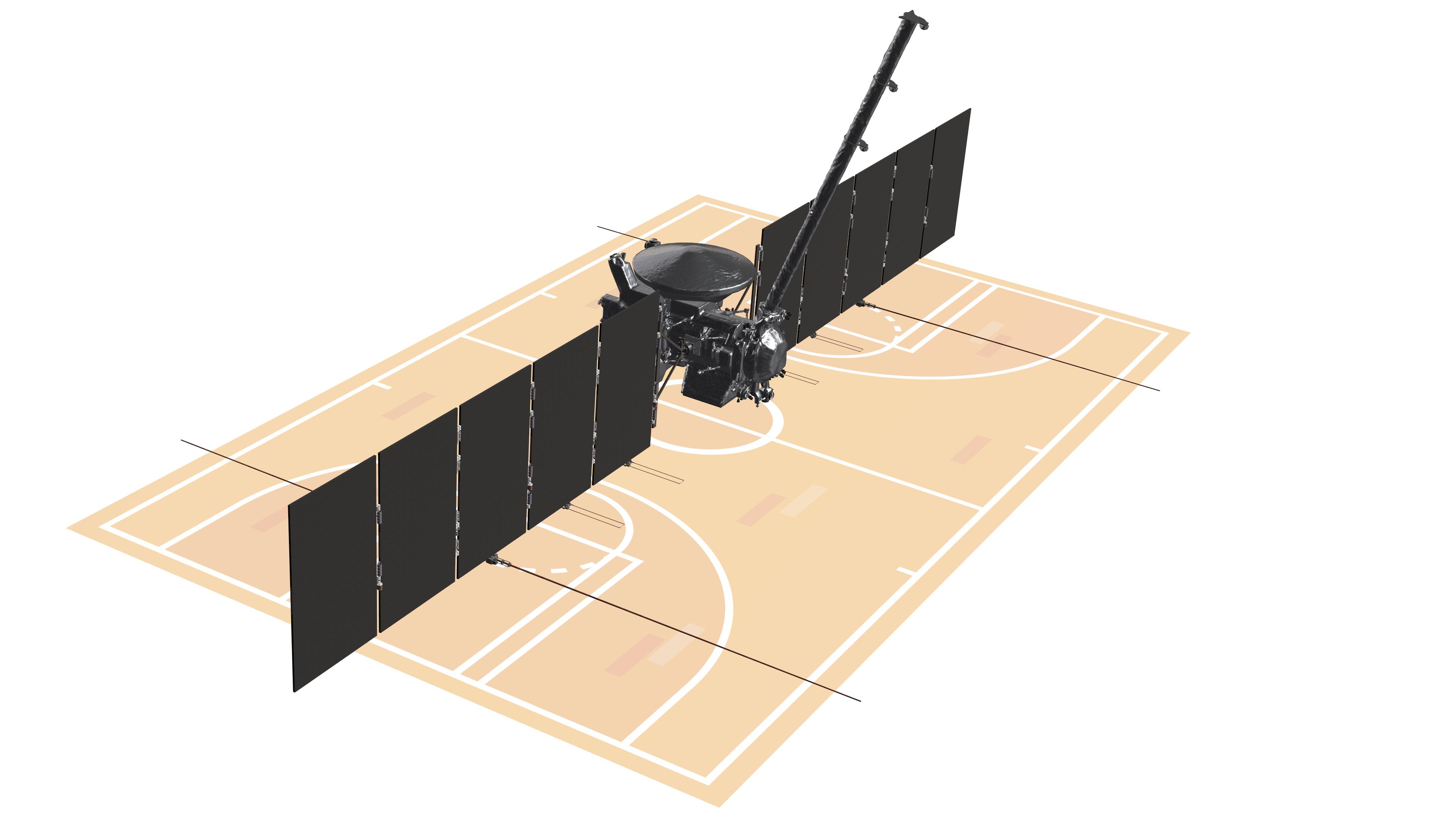
Which shows that 30-meter mirrors definitely can be launched into space. You just have to fold it very carefully because you also need the laser transmitter to be folded into the center where it can detach once it's in space.
Elara space components must be designed to be _as simple as possible_ and use _as few moving parts as possible_. The voyager probes only worked so well because they were designed with technologies that were simple enough to be easily repaired and so simple that they had few points of failure.